Water Rocket Manual
Everything You Ever Wanted to Know About Water Rockets and Launchers
Free Water
Rocket and
Launcher Plans
Get your free detail plans for a water rocket with fin templates, and a launch tube type launcher with a Clark cable tie release complete with parts list, and detailed step-by-step instructions anyone can follow. Instructions for downloading will be emailed immediately after submitting the form below.
After submitting your name and email address, you will receive a confirmation email. You must respond to the email to verify that the email is correct and valid and to confirm that it is you requesting the information. After confirming your email, you will receive a second email with download instructions for the information you are requesting. We will only keep your email address to let you know when the complete manual is available an rarely if ever any other emails from us.
Privacy Policy
Your information is never shared with
anyone else...ever!
Once you have downloaded and looked over the free instructions, why not visit my blog and let me know what you think...
Click here to go to my blog.
Also, if you haven't already, visit my amateur rocketry website here where you can learn how to build your own rocket motor from PVC pipe with sugar and potassium nitrate KNO3) propellant called caramel candy propellant or rcandy (for rocket candy).
How Bottle Rockets Work
The intricate details of the math and science of water rockets is reserved for a chapter in volume 2 of The Complete Water Rocket Manual but a brief explanation is in order before we get into building your first water rocket and launcher.
A water rocket uses the same physics as a model rocket or the Shuttle launch vehicle. Very simply, a rocket engine uses high pressure to force a fluid through a restricted opening at a high velocity and this creates a force that propels the launch vehicle in the opposite direction from the exhausting fluid.
Technically, a fluid is either a gas or a liquid. In chemical rockets, the fluid is a superheated gas generated from a burning fuel. In a water rocket, the temperatures are normally near outside temperatures and the fluid is a combination of gas and liquid, the gas being normally air (although carbon dioxide, or nitrogen are also sometimes used and a hydrogen-oxygen mix is used for a hydrogen rocket) and the liquid being water (though it could be mixed with salt or bubble bath or other ingredients).
It is Newton’s laws at work and especially his third law of motion simply stated as “Every action has an equal and opposite reaction.”
Five Phases of Flight
A bottle rocket has four or five phases of flight as opposed to three for chemical rockets.
- Acceleration due to pressure acting against the launch tube. (This is not present if a launch tube is not used)
- Acceleration due to the reaction force of the water being ejected.
- Acceleration due to the reaction force of the air being ejected.
- Coast phase (ending at apogee, the highest altitude reached), which is the longest part of the upward flight. The acceleration phases using just the open neck of the bottle as the nozzle are in milliseconds.
- The recovery phase where the rocket returns to earth after reaching apogee.
Optimum Amount of Water to Use.
"How much water should I put in mhy water rocket?" That is a frequently asked question. The amount of water used in the rocket makes a huge difference in the altitude reached. Actually, using no water at all but simply using the compressed air for thrust can propel an aerodynamically efficient water rocket to surprising altitudes.
If you put too much water in, then the thrust available must loft more weight, which reduces the maximum altitude. An air only rocket can fly higher than one with too much water.
If too little water is used, then there isn’t enough reaction mass to propel the rocket most efficiently. The exact most efficient amount of water varies depending on the overall empty weight of the rocket and whether or not a launch tube is used. The graph below shows a 2 liter bottle rocket weighing 150 grams and 250 grams, using a launch tube and not, and with a fairly large drag coefficient for an example. For this rocket, the optimal amount of water with a launch tube is 22% for 150-gram rocket weight, 30% for a 250-gram, and without a launch tube is 29% for 150-gram one, and 37% for a 250-gram rocket.
So you can see that the more the rocket weighs, the more water it needs to reach the maximum altitude and the longer the launch rod, the less water it needs. Also notice that with a launch tube, actually the heavier rocket reaches a higher altitude. That is because by using the pressure working against the launch tube, the launch tube can impart a greater momentum so the inertia will carry it farther. It combines the affect of a bullet in a gun and a rocket motor. You can find more details on this in the Science and Math chapter.
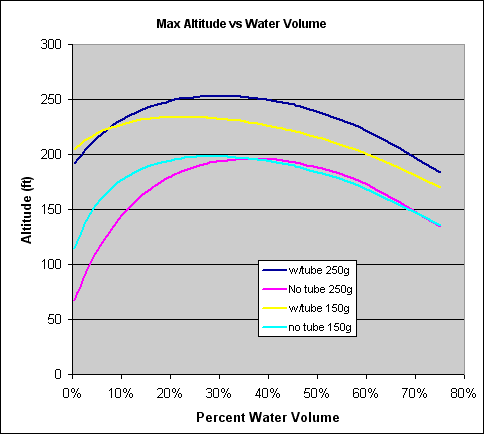
There are other factors involved any reasons why you may want more than the optimum amount of water. This and many other topics are covered in
The Complete Water Rocket Manual
volumes 1 & 2
...coming very soon. Order your free sample by filling in the form at the top of this page on the left or send an email to
How a Launcher Works
The Basics
The minimum requirements for a launcher are:
- A way to pressurize the bottle
- A seal to hold the water and pressure in the bottle until it is launched
- A way to keep the rocket from launching until there is enough pressure
As stated before, there are as many designs for launchers as people using them. However, if we just consider the most common and popular launcher types, we can divide them into these categories:
- Hand Held
- Friction Plugs
- Latched
- Launch Tubes
Hand Held
A hand held launcher is sealed some way, usually an o-ring, and is held on the launcher by hand as pressure is increased by an air pump. To launch, the person holding the bottle on the launcher merely lets go.
Friction Plugs
These are the simplest form of launcher and are comprised simply of a cork or rubber stopper with a tube through it or a tire valve plugging the nozzle throat whether it is just the bottle neck or a hole in a cap. A tire pump or pressurized gas supply is attached directly to the tube or tire valve or indirectly with a longer hose. The bottle is then pressurized and at some point where the pressure in the bottle overcomes the friction fit, the plug is blown out of the bottle and the bottle is launched.
Although this is the simplest method, the pressure at which the plug is blown out is very unpredictable. It could happen at 30 psi or 200 psi (which is likely to burst the bottle).
A rocket that is sitting flat on the ground on its fins may launch straight but may not. Any irregularities in thrust, off centered center of gravity, or non-symmetrical features on the outside of the rocket such as non-identical fins or adhesive can affect the initial direction the rocket will fly. For consistency an external guide rod will be required to insure a straight flight. A guide rod guides the rocket straight in the first few feet of its flight until the air flow over the fins is sufficient for them to take over that job.
Latched
The latched type of launcher overcomes the unpredictability of the friction plug type by holding the bottle securely until it is ready to launch. When the desired pressure is reached (assuming a pressure gage is in the system), the bottle is unlatched and launches. As with the friction plug, this kind of launcher still needs an external guide rod for a stable flight.
Launch Tube
The launch tube fits through the neck of the bottle almost to the top of the bottle on the inside. The launch tube system in its simplest form can be made without a latch but it has to have a seal, usually an o-ring. The more common launch tube launchers also have a latch that is remotely tripped. Either way, it overcomes both problems. It is launched when desired rather than at a random point and the launch tube, which runs up inside the bottle, guides the rocket straight eliminated the need for an external guide. It also adds considerable additional velocity and so higher maximum altitude.
The Simplest Launch Tube Launcher – Hand Held
The simplest launch tube launcher without a latch actually does have a latch – you. One person can pump while another holds the rocket on the launch tube. For one person use, a foot pump, electric compressor or gas cylinder could be used. A compressor would have to be protected from the water.
When ready to launch, the person holding on to the rocket simply lets go. This should only be used at lower pressures far below the burst pressure of the bottle, 40 to 50 psi max. This launcher should also be tall enough so that the bottle is overhead just in case the bottle does burst, the person holding it is out of the way of the “blast.” In the case of children, different heights of launch tubes would have to be made for the different heights of the kids.
Kids especially may enjoy this because the person holding the bottle DEFINITELY GET WET! This can be a big source of fun and laughter besides being a very simple launcher to build.