|
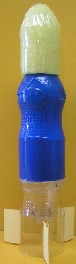
The Plutoid 1B Water Rocket.
Your first water rocket explained
in step by step details in the
free plans you can get by filling in the form on the left.
|
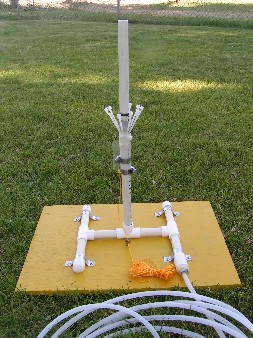
The Alpha Base Launcher.
Your first water rocket launcher
explained in step-by-step details
also covered in the free plans
you can get by filling in the form on the left.
|
|
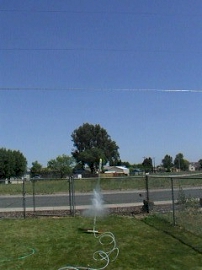
Actual launch of the Plutoid 1B
from the Alpha Base launcher.
Flight
video,
Bounce recovery, 5 sec video clip:
wmv 640X480, 200 Kb
mpg 640X480, 2.6 Mb
|
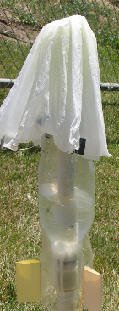
Parachute draped over nosecone,
the simplest deployment covered in Chapter 6 of
The Complete Water Rocket Manual vol 1
|
|
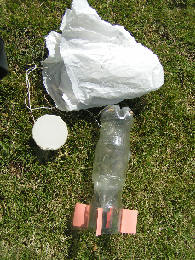
Air stream flap parachute deployment,
an easy and reliable deployment method covered in Chapter 6 of
The Complete Water Rocket Manual vol 1
|
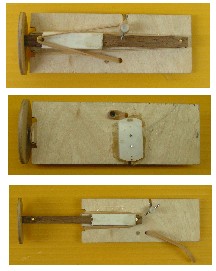
Vertical deployment "Tomy Timer"
ejection mechanism. Detailed in
chapter 6 of
The Complete Water Rocket Manual vol 1
|
|
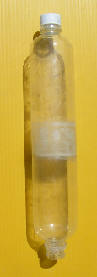
Two spliced bottles. Pressure
tested to 140 psi with no leaks.
Learn how in chapter 4 of
The Complete Water Rocket Manual vol 1
|
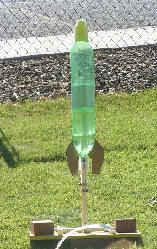
A version of the
Nova 1B Rocket
made from two 2-liter bottles
on the Alpha Base launcher.
This and many more rockets detailed in chapter 7 of
The Complete Water Rocket Manual vol 1
|
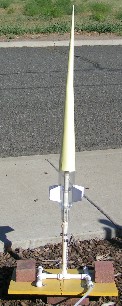 |
The "Coney"
The rocket in the picture to the
left is based on Robert Youen's "Coney." This is a backslider
or back-gliding rocket. Robert and Peter Alway did extensive
research and obtained a patent on backsliders. Their work
was done with a 55 diameter long rocket and their patent references
a 30:1 and 50:1 length. Robert Youen's Coney (and the one
pictured here) is 12:1 and is not tubular in shape so the effective
ratio is even less. The result is that even when properly
built and precisely balanced according to the Alway report, it
is not dependable. Click on the picture or
here to see a mp4, 12 second,
clip of how a "perfect flight" can go wrong. The
clip is about 12 seconds long. At 9 seconds it disappears
(into a black hole?) for a second and then reappears falling vertical
and accelerating into the ground.
Here is a clip of how a coney flies correctly.
In the book, I give you
the correct balancing location for this rocket to backslide correctly.
Click on the links for the "real" perfect flight.
A complete discussion of backsliders
and the "Coney" is in chapter 3 of
The Complete Water Rocket Manual
vol 1.
|
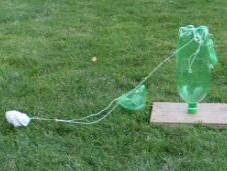 |
Here is a ground test of a 2-liter
bottle rocket with an airspeed flap recovery system ready to go
except for fins being ground tested. Click on links below
a normal speed (1 second) and a slow speed (4 second) video clip.
Normal Speed 2 sec
Slow Speed 4 sec
|
|
|
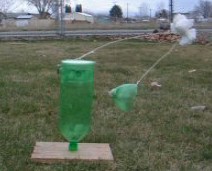
Similar to above,
this is a ground test of a bottle rocket with a tomy timer parachute
ejection. The rocket is ready to go except for fins.
The timer here is set for about 5 seconds which would be too long
for an actual flight. An actual flight of this rocket should
be set for about 3-4 seconds to deploy at apogee.
Tomy Timer Delay Ejection Test 320X240
mpg 7 sec
|
“The Complete Water
Rocket Manual"
Coming Very Soon
Download two
chapters from volume 1 for free by filling in the simple form on
the home page then we'll contact you when the
manual is released
or
send an email to:
notify@waterrocketmanual.com